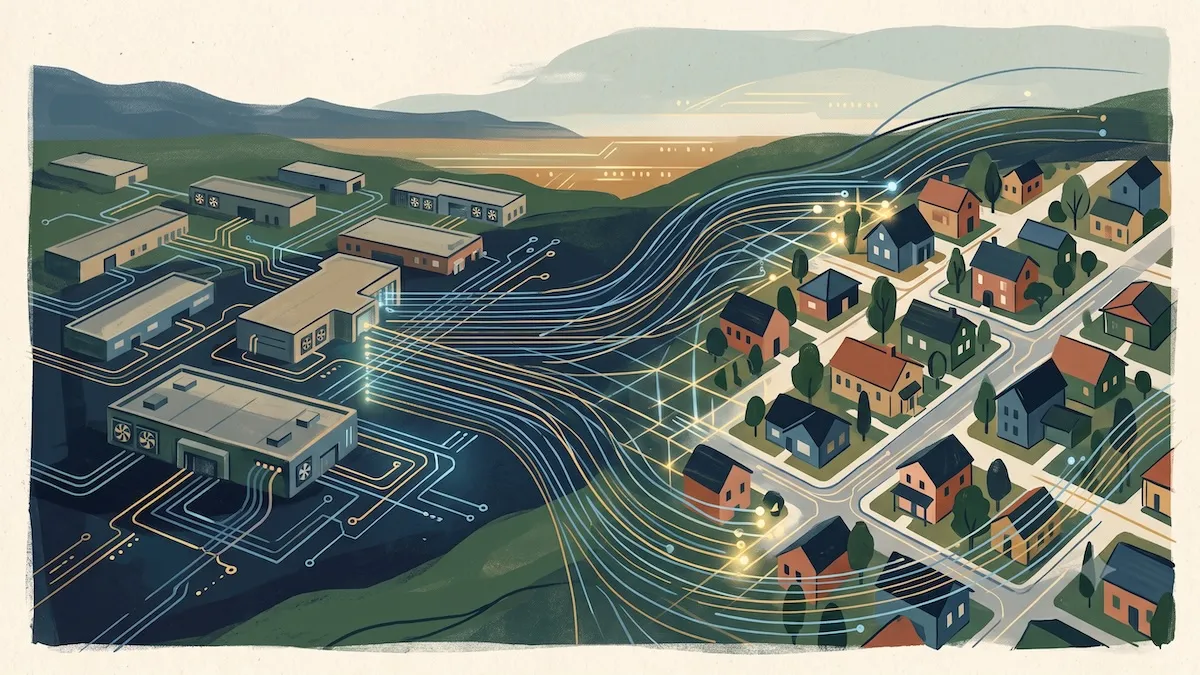
Data centers have become an unpredictable force reshaping property valuations and market dynamics across the country. Real estate professionals struggle to price these facilities accurately because traditional appraisal methods fail to capture their unique characteristics and rapidly evolving demand.
Agents report that data center developments attract institutional investors and tech companies willing to pay premium prices for land in specific regions. Markets near fiber optic infrastructure and power supply hubs see accelerated bidding wars. Properties in areas without these advantages face potential obsolescence, creating stark disparities in neighboring communities.
Appraisers face the biggest challenge. Data centers lack comparable sales data. Their value depends on technical specifications like cooling capacity, electrical infrastructure, and proximity to telecommunications networks. The buildings themselves generate minimal property tax revenue per square foot compared to commercial office space. A 500,000-square-foot data center might pay taxes on assessed value that underperforms relative to a smaller mixed-use development.
For sellers, data center proximity can significantly boost land prices if infrastructure aligns with industry needs. Landowners in rural areas near power plants or fiber hubs have capitalized on sudden demand spikes. Conversely, properties in regions without tech investment see stagnant valuations while neighboring parcels command multiples higher prices.
Buyers and developers face pricing uncertainty. A parcel valued at $50,000 per acre might jump to $150,000 if a major data center operator targets the region. Lenders struggle to underwrite loans on properties dependent on speculative demand from tech companies. Appraisal gaps between lender estimates and market reality create financing obstacles.
Tenants and landlords in office buildings adjacent to data center construction report mixed results. Some office rentals rise as tech employment grows. Others decline as companies prioritize proximity to data centers over traditional downtown cores, hollowing out secondary markets.
Real estate professionals now factor in data center proximity as