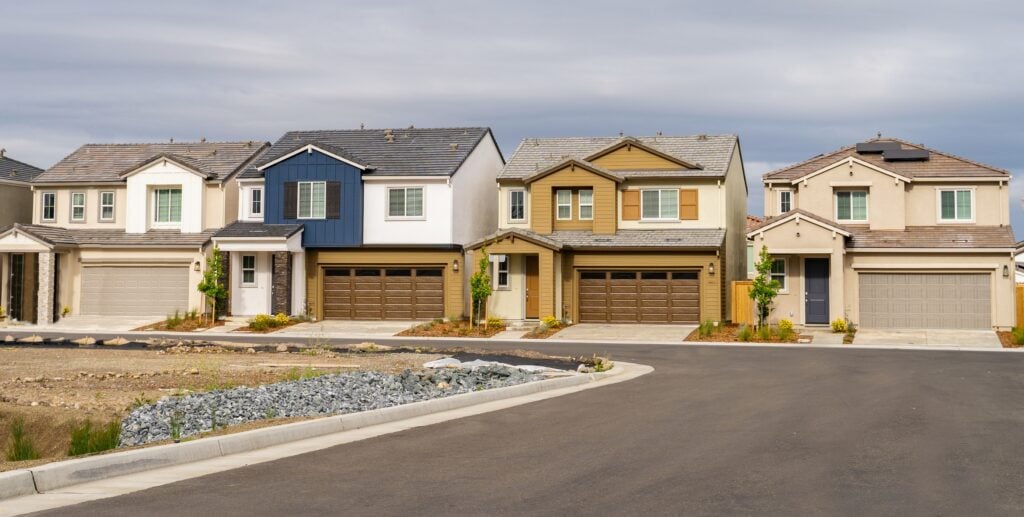
New construction investors have already moved while others wait for mortgage rates to fall further. Developers and institutional buyers locked in 4% financing months ago, securing both land and inventory before rates stabilized at higher levels.
The delay strategy backfires for passive investors. Those sitting on cash hoping for sub-4% mortgages miss development cycles and competitive bidding wars. New construction projects typically require committed financing before groundbreaking. Developers financing through construction loans tied to forward-rate agreements already priced in current market conditions. Waiting another quarter accomplishes little when new projects price in existing rate expectations.
Active investors understand the math. A $2 million new construction property financed at 4% costs $9,551 monthly on a 30-year mortgage. That same property at 5% jumps to $10,736 monthly. The $1,185 monthly difference compounds over decades. Yet hesitation leaves investors with neither low rates nor available inventory. Developers release phases based on pre-sales momentum, not individual buyer timelines.
Cash-holding investors face a three-part problem. First, construction timelines typically run 18 to 24 months from purchase to completion. Rate assumptions baked into current developer pricing already account for likely market conditions at closing. Second, new construction absorption rates depend on investor participation. Light buyer interest slows phase releases and pushes developer timelines backward. Third, waiting wastes carry costs. Holding capital without deployment generates zero returns while construction buyers build equity from day one.
The practical takeaway for fence-sitters: lock in available terms now rather than chase phantom rate drops. Refinancing remains possible if rates genuinely collapse below 3.5%, though lenders rarely drop rates that far this cycle. The realistic scenario keeps rates between 4.5% and 6% through 2025. Developers already priced their projects for this environment.