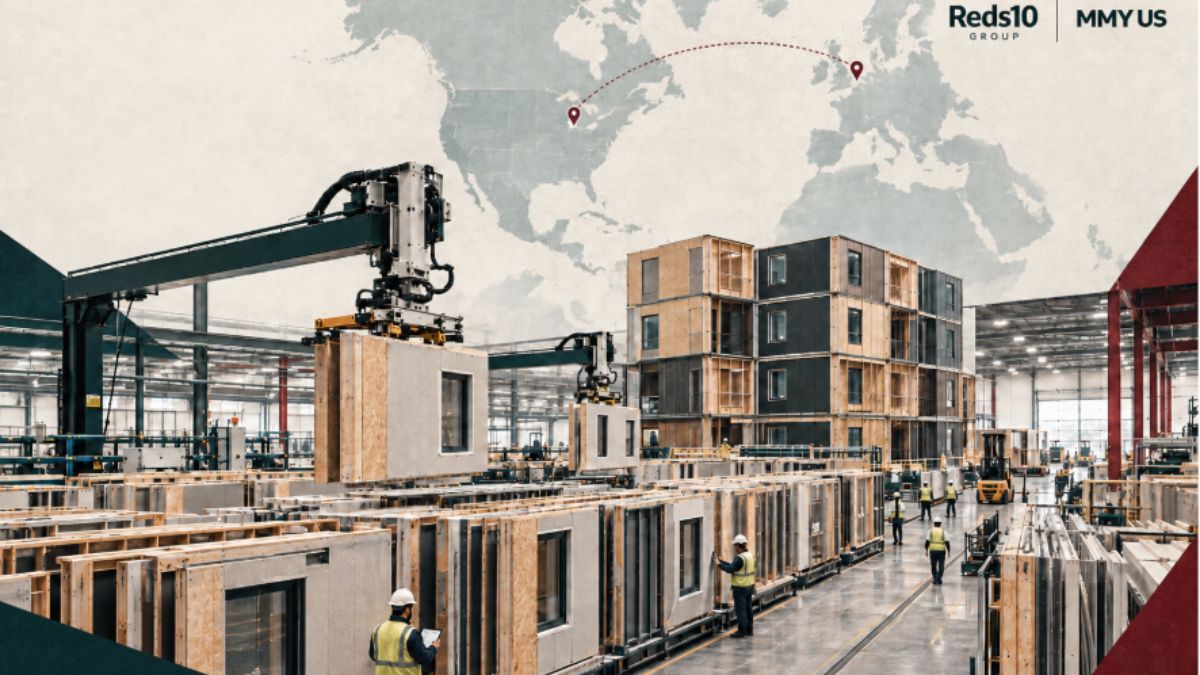
Reds10 Group, a European modular construction specialist, has acquired MMY US, establishing its first North American foothold through an off-site manufacturing platform. The deal positions Reds10 to scale modular building technology across the United States at a moment when prefabrication methods are gaining traction among developers facing labor shortages and construction delays.
MMY US operates an existing modular manufacturing facility in Louisville, Kentucky. The company is developing plans for a second factory in Cleveland, Ohio. These facilities will produce volumetric modules, pre-assembled building components that arrive on-site ready for rapid assembly. This approach cuts construction timelines by 20 to 40 percent compared to traditional stick-built methods.
Reds10 Group brings European expertise in offsite construction to a U.S. market increasingly desperate for speed and predictability. European modular builders have perfected industrial-scale production over decades. American developers, by contrast, have relied heavily on traditional construction crews, a model now strained by worker shortages, wage inflation, and project delays.
The Louisville facility gives Reds10 immediate production capacity. The Cleveland expansion signals confidence in Midwest demand. Both locations position the group near major metropolitan areas with dense multifamily and commercial development pipelines. Louisville serves Tennessee and Kentucky markets. Cleveland opens access to Ohio, Pennsylvania, and the broader Northeast corridor.
For residential developers, this acquisition matters. More modular capacity means faster timelines for apartment complexes, senior housing, and workforce housing projects. Reduced construction cycles translate to earlier lease-up, faster revenue recognition, and lower financing costs. Developers in supply-constrained markets gain a competitive edge.
For general contractors, the shift toward modular production creates both opportunity and pressure. GCs that partner with modular suppliers can win bids faster and deliver projects sooner. Those resisting prefabrication risk losing work to competitors embracing the technology.
For lenders, modular construction reduces risk. Shorter build periods mean lower carrying costs and earlier cash flow generation. Construction loans perform better when projects finish on schedule. Permanent lenders benefit from faster lease-up timelines and more predictable performance.
Landlords and property managers see operational benefits. Modular construction produces fewer defects. Components undergo quality control in factory settings rather than on-site in variable weather and staffing conditions. Move-in timelines become more reliable.
The Cleveland expansion represents Reds10's confidence in sustained U.S. demand. A second factory wouldn't make economic sense without strong pipeline visibility. The company expects robust utilization across both facilities within 24 to 36 months.
This acquisition reflects a broader market shift. Modular construction in the U.S. remains a fraction of total building activity, roughly 5 to 8 percent. European penetration rates exceed 25 percent in some segments. Reds10's U.S. entry suggests that gap will narrow as labor remains tight and developers demand faster delivery.
The Midwest location strategy also signals where growth is concentrated. Cleveland and Louisville offer lower real estate costs than coastal markets, proximity to major demand centers, and access to local incentive programs that many states now offer for manufacturing operations.
Reds10's American operations will test whether European modular models transfer directly to U.S. market conditions, supply chains, and regulatory environments. Early success here positions the group for national expansion.